
Many people stumble into this topic because they associate “armed” with greater safety or higher status. In practice, an armed security guard in Vienna is first and foremost someone who takes rules seriously, can handle pressure, and still stays clean — in their head, in their tone, and in their documentation.
I’m saying this that directly because I’ve seen it too often: if you focus only on the weapon, you miss what actually matters. Armed assignments are rarely an entry point; they’re more of a specialization you earn over time — and one you can also lose again if you become unreliable.
This text is meant to help you get your bearings. It does not replace official guidance, and it does not explain “how to get a weapon.” It explains how you grow into a regulated profession in a serious way, and which requirements for armed security guards in Vienna really matter in day-to-day work.
Tasks and Responsibilities of Security Personnel
Most shifts are uneventful — and that’s exactly a good sign. In armed assignments, the point isn’t to “clamp down,” but to spot risks early and act in a way that prevents things from ever getting loud.
A small, typical moment: someone tries to slip in “just quickly” through a side door because the main entrance is annoying. If nobody is clearly responsible, that “just quickly” turns into a pattern. And in security work, patterns are often more dangerous than one-off exceptions.
The Austrian Economic Chamber notes that, depending on the assignment, guards may also handle dogs and carry weapons. That alone shows the point: being armed is not the default; it’s tied to the type of deployment and its conditions.
The boundary is always important: security staff are not the police. Duties and powers are different, which is why clean reporting, clear communication, and a sensible escalation path are part of the job — not “bureaucracy on the side.”
Where Armed Assignments in Vienna Make Sense at All
Armed posts appear where the risk is genuinely higher: sensitive locations, high-value assets, certain VIP constellations, or situations where you have to reckon with specific threat scenarios. That sounds more dramatic than it usually feels day to day — but the assessment has to stay sober.
PSM Austria describes armed services primarily for high-risk environments: protecting high-value assets, VIP/executive protection, and security solutions for sensitive sites.
And yes, sometimes the best solution isn’t armed at all, but simply better organized: access processes, technology, lighting, clear responsibilities. Being armed is a specific answer to a specific problem — not the “premium version” of security.
What Makes You Stronger Than Any “Tough” Pose
If I’m honest: fitness is rarely what candidates fail on. It’s the quieter things — patience, attention to detail, clean writing, and the ability to think clearly even at 04:30.
In Vienna, there’s also a social component. You often work with people who aren’t malicious, but stressed, drunk, confused, or simply impatient. A good security professional can stay friendly without becoming soft — and that’s exactly the demanding part.
If you want to check whether you have the basics, these points help. They’re not “flashy,” but in practice they decide a lot.
- De-escalation: staying calm when others tip over
- Observation: spotting patterns before they become an incident
- Communication: speaking clearly without provoking
- Documentation: precise, traceable, timely
- Teamwork: handovers, radio discipline, clear roles
These skills are also the reason why many paths start with unarmed assignments. If you work reliably there, you’ll have better chances later — including when it comes to training for armed security guards in Vienna and more demanding posts.
Requirements and Compliance in Austria
The keywords show what many people are looking for: license for armed security guards, license for armed security guards in Vienna, requirements and registration for guards, registration as a guard in Vienna. The issue is that in everyday conversation, people quickly mix up company law, trade law, and weapons law.
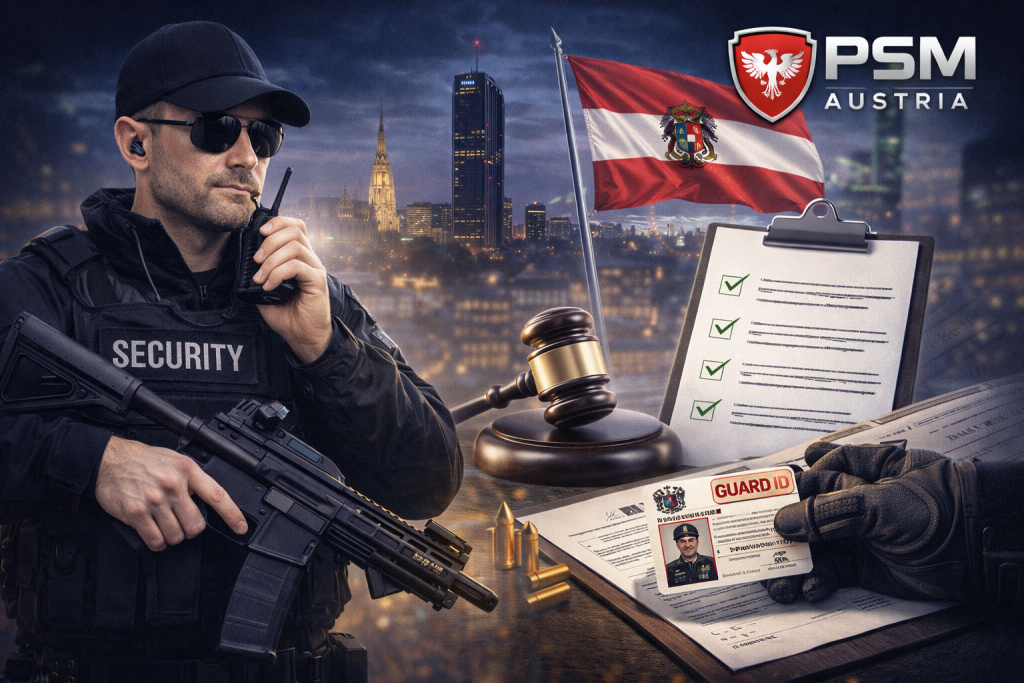
The guarding trade in Austria sits within the security trade framework, including access requirements under the Security Trade Regulation.
The weapons-law side is its own field. Official information on weapons law and documents such as the weapons pass can be found on oesterreich.gv.at, including the explanation that a weapons pass also authorizes the carrying (having on one’s person) of firearms.
It sounds complicated, but the logic is straightforward: the company needs the right authorization, the individual needs suitability and reliability, and armed assignments additionally require that weapons-law conditions are met. Anyone who sells you this as “one form” is oversimplifying reality.
Training and Onboarding
Good training is not “one course and done.” It’s more like a system: instruction, standards, scenarios, feedback. In security work, that’s not a nice-to-have — it’s necessary, because improvising at the wrong moment can get expensive.
If you’re specifically looking for training for armed security guards in Vienna, think in terms of building up through experience. First fundamentals, then operational routine, then specialization. Armed work isn’t something you “wish for”; it’s something you’re selected for when assignment, qualification, and trust line up.
If you want a picture of what matters in onboarding, these training areas are a solid orientation.
- Law & boundaries: powers, conduct, escalation paths
- De-escalation: defusing conflict without loss of face
- Access & processes: checkpoints, visitor control, clear routines
- Reports: shift logs, incidents, clean handovers
- Emergency procedures: first aid, evacuation, communication
And to avoid misunderstandings: we do not provide instructions on obtaining or handling weapons here. If armed assignments become relevant, strict legal and internal requirements apply — and the path there is deliberately controlled.
Recruitment Process at PSM
Many people expect a “quick check” and then the assignment. That’s not our approach. Security work is trust work, and you don’t build trust in a single phone call.
At PSM, the core is suitability, reliability, and the ability to function cleanly within a team. That includes conversations, assessments, references/documents depending on the role, and onboarding that is grounded in the real assignment — not just theory.
If you apply, don’t write only “I want to work armed.” Write where you currently stand, which shifts are realistic, what experience you have, and what you want to learn. That’s a much better starting point than a big goal without a foundation.
Why You Can Trust PSM
Numbers aren’t everything, but they’re a signal of whether a provider is stable. PSM Austria publicly communicates, among other things, 14+ years of experience and a Google rating of 4.9/5.0 (105 positive reviews). If you want to put that in context, you can check it directly on the website.
What matters especially for armed assignments is less size than culture: clear processes, clean leadership, consistent training, and the ability to treat restraint as a strength. It doesn’t sound spectacular — but it works.
If you want to grow toward armed assignments later, a stable start in unarmed roles is often the fastest route: good handovers, clean reports, reliable communication. That’s the part many underestimate, but it tends to matter most internally.
Work With Us
If you’d like to work with us, reach out with a short, honest application: who you are, what experience you bring, which hours are realistic for you, and why you want to work in security — without a hero story.
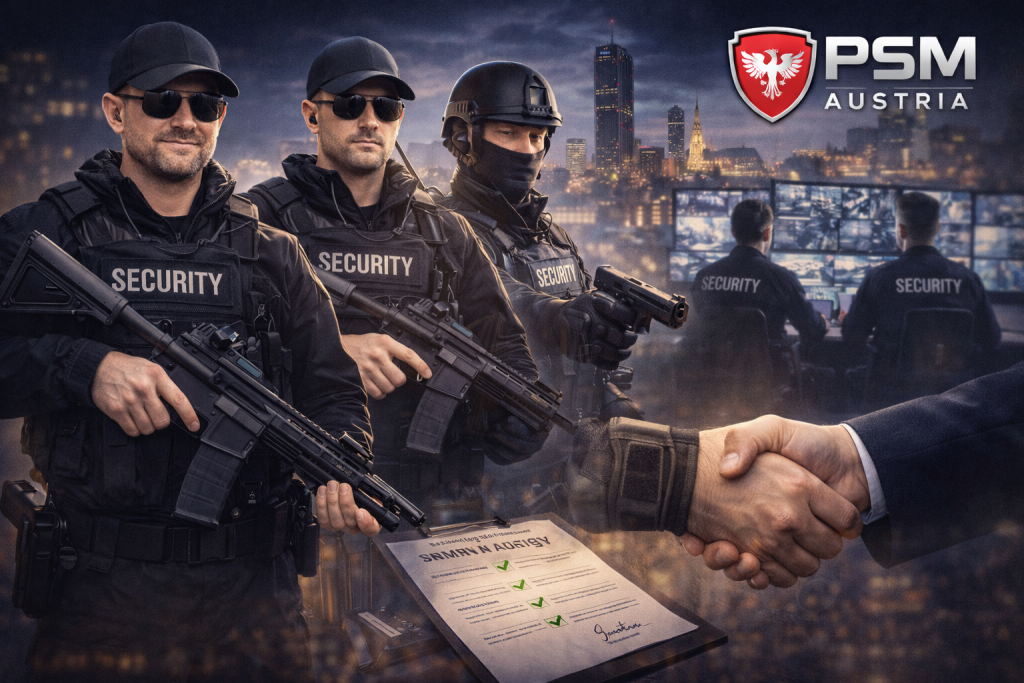
We’ll then discuss which role fits and what your entry could look like. For some, that’s an object post; for others, a reception/control point; for others, a more dynamic area. And if armed tasks become relevant later, we’ll speak openly about prerequisites, development, and the framework conditions.
You can contact us here: PSM Austria – Contact. If you’d like an overview of our services first, start here: PSM Austria – Services