
The entrance of a property sets the tone for everything that follows. In Vienna and other Austrian cities, the first seconds at the door decide whether visitors feel welcome, safe, and well guided. At the same time, access control and security remain critical. This is where the difference between a doorman service and a normal security service becomes very clear.
Many property owners still see “a guard at the entrance” as a single category. In practice, there is a sharp difference between a classic security guard and a concierge-style doorman service that combines hospitality with security. Understanding this difference helps decision-makers choose the right entrance solution for their office building, hotel, or residential complex.
What is a concierge or doorman service?
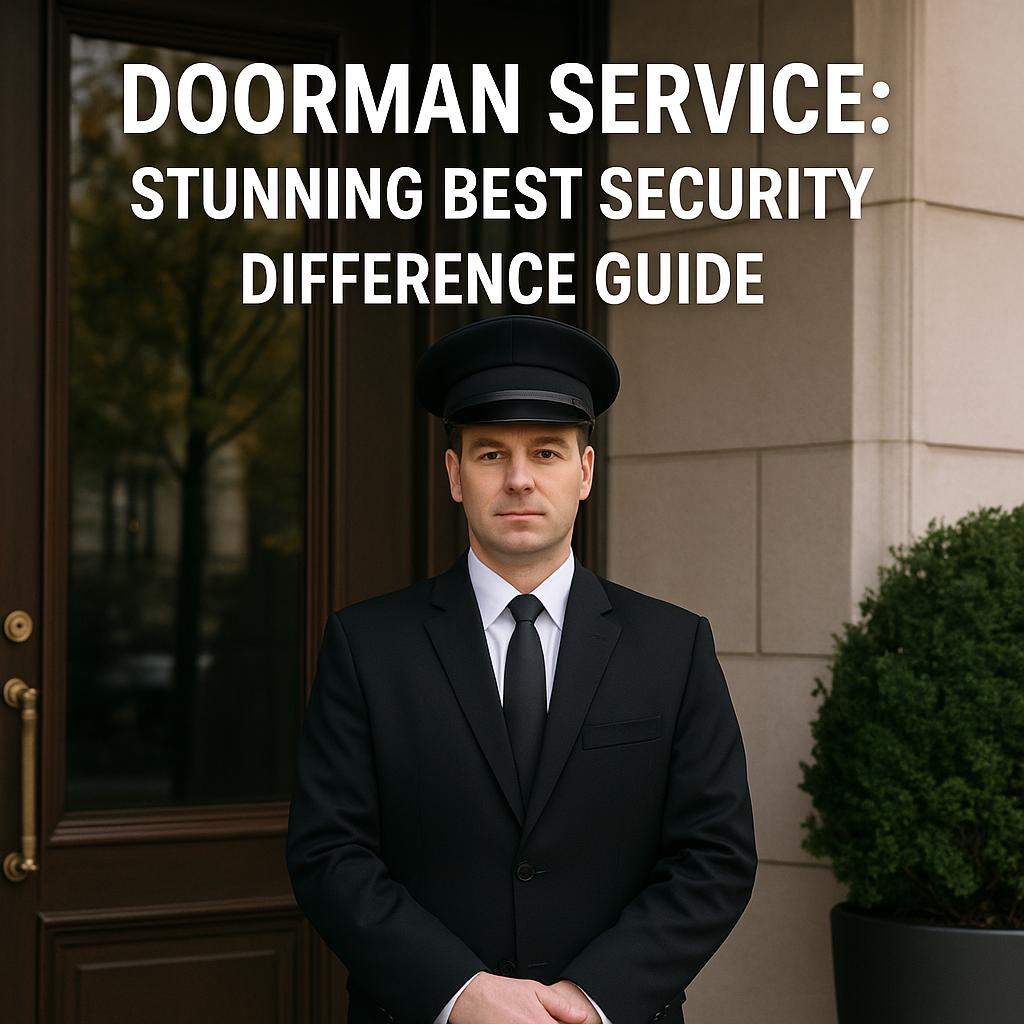
A doorman service, often called concierge service in Austria, focuses on guest care and building management at the entrance. The person at the door welcomes guests, answers questions, and controls access. At the same time, the concierge observes the entrance area, identifies risks early, and coordinates quick response if something goes wrong.
The key idea behind a professional doorman service is a mixed role: part host, part receptionist, part entrance security specialist. The concierge knows regular tenants by face, understands daily routines in the building, and keeps an eye on everything that happens at the front door. This mix gives a much more human and service-oriented experience than a standard guard post.
Main tasks: doorman service vs. traditional security service
A doorman service and a normal security service share one goal: protect people and property. Their daily tasks, methods, and interaction with visitors differ a lot. This affects how staff behave at the entrance and how visitors remember your property.
| Aspect | Doorman / Concierge Service | Normal Security Service / Guard |
|---|---|---|
| Main focus | Guest experience + entrance security | Protection and incident response |
| Interaction style | Friendly, service-driven, helpful | Formal, more distance, control-driven |
| Typical uniform | Elegant, front-desk style, discreet | Clearly marked security uniform |
| Tasks at reception | Welcome, guide, answer questions, call lifts, sign for parcels | Check IDs, manage access lists, lock / unlock doors |
| Security tasks | Observe entrance, handle minor issues, de-escalate calmly | Patrol, react to alarms, enforce rules |
| Target areas | Hotels, premium offices, residential complexes | Industrial sites, events, logistics, high-risk areas |
| Perception | Part of the “face” of the property | Primarily seen as security measure |
In practice, many companies in Austria now combine both roles. They choose a doorman service with full security training, so the concierge can provide front desk security service in a residential complex or office lobby, while keeping the friendly, guest-focused appearance that tenants expect.
Typical tasks of a doorman or concierge service
A concierge or doorman does more than stand at the door. The role covers several small but important tasks that keep daily operations smooth and safe. These tasks often decide whether entrance security feels strict and cold or professional and welcoming.
In a modern doorman service Vienna office building, daily tasks can include:
- Greeting tenants, guests, and suppliers with a short, polite welcome.
- Checking visitor lists, issuing badges, and guiding guests to meeting rooms.
- Managing keys or access cards for contractors and cleaning staff.
- Coordinating taxi arrivals, courier deliveries, or tradespeople.
- Monitoring CCTV screens focused on the entrance and lobby.
- Noticing unusual behaviour and starting de-escalation early.
- Answering simple questions about directions, house rules, or local services.
- Handling parcel acceptance for tenants under clear guidelines.
Imagine a guest arriving at a Vienna office in the rain, unsure where to go. A classic security guard might point to a lift bank and check ID. A concierge will still check ID and access rights but will do it while offering a short explanation, a clear route, and maybe a simple “You are on time, the meeting room is on the 5th floor to the left.” That small change shapes how the whole building is perceived.
Typical tasks of a traditional security service
A normal security service focuses on protection, rules, and fast reaction to any threat. Guards often work across larger areas and have a wider patrol route than a concierge fixed at the entrance.
Common security guard tasks include:
- Patrolling indoor and outdoor areas according to a fixed plan.
- Checking doors, windows, and gates to prevent unauthorised access.
- Responding to alarms or technical alerts from security systems.
- Reporting incidents, damage, or suspicious behaviour to supervisors or the client.
- Cooperating with police or emergency services during serious incidents.
Many sites in Austria still need this classic model, for example logistics centres, factories, or construction sites. For a high-end office or residential building in Vienna’s inner districts, the question is different: how to combine entrance security with a high level of service without turning the lobby into a strict checkpoint.
Entrance security: doorman vs. security guard
The difference between entrance security doorman vs security guard becomes very clear the moment a conflict appears. A doorman service focuses first on calm communication. The concierge tries to solve the issue through information, clear rules, and a friendly but firm tone. A traditional guard applies more direct security procedures.
For example, a visitor tries to enter an office building outside visiting hours. A doorman will explain the rule, check if there is an exception, offer to call a contact person, and stay polite but firm. A guard will focus on refusal and boundary setting first, with less focus on guest experience. Both protect the building; the path to that result is different.
Where a concierge or doorman service is especially useful
Not every site needs a concierge service. For some properties in Austria, a normal security guard is enough. For others, the doorman approach adds clear value, especially in places where image, comfort, and long-term guest relationships matter.
Hotels and serviced apartments
In hotels, the concierge or doorman is a standard feature. Guests expect support with luggage, taxis, and quick answers. A doorman service here builds trust from the first second at the door. The same logic applies to serviced apartments in Vienna: residents pay for comfort and want a human contact point in the building, not just a camera and an intercom.
Residential complexes
In a modern residential complex, front desk security service must protect residents while staying discreet. Families, older people, and international tenants want a safe entrance without feeling observed at every step. A concierge solves this by acting as a central point of contact.
Typical benefits in a residential context include:
- Better control of visitors and service providers without making residents wait.
- Parcel management that reduces lost deliveries and reduces stress for tenants.
- Fast reaction to noise, minor disputes, or strangers in the building.
- Support for elderly residents who may need assistance with taxis or directions.
For property owners, this has a direct effect on satisfaction rates and tenant retention. A visible but approachable doorman service makes a large building feel more personal and safe at the same time.
Office buildings and corporate headquarters
In a Vienna office building, the entrance is part of the brand. Clients, partners, and job candidates form their first opinion in the lobby. A doorman service that understands corporate etiquette will welcome guests, coordinate check-in, and make the visit feel smooth and organised.
A doorman service in this context usually:
- Checks visitor pre-registration systems and prints badges.
- Informs hosts by phone or system when guests arrive.
- Aligns with facility management on meeting room access and cleaning cycles.
- Supports evacuation procedures and emergency drills.
A normal guard can do access control, but a concierge adds an extra layer of value. Visitors do not feel “checked” but “welcomed and guided”, while access rules stay clear and enforced.
Mixed-use properties and multi-tenant buildings
Many new projects in Austria combine retail, offices, and apartments in one building. In such mixed-use sites, a pure security focus at the entrance often creates friction. Shoppers want an open atmosphere, but offices and residents need strict access control.
A concierge service is well suited for this mix. The same doorman can take on several roles over the day: morning peak with office workers, quiet midday with parcel services and cleaning staff, afternoon and evening with residents returning home. This flexible entrance security model works better than fixed patrols alone.
PSM Austria’s doorman and concierge service
PSM Austria has developed a doorman service that combines classic security know-how with strong service skills. The focus lies on entrance areas where both image and safety are key, such as Vienna office buildings, high-quality residential complexes, and hotel entrances.
PSM Austria’s approach to concierge and doorman service includes:
- Careful staff selection with strong social skills and clean communication.
- Training in access control, conflict management, and guest care.
- Knowledge of local conditions in Austria, including language skills and cultural norms.
- Coordination with technical systems such as access control, CCTV, and alarm centres.
This allows PSM Austria to cover both sides of the entrance: a human, service-driven appearance for guests and tenants, plus professional building protection in line with legal and insurance requirements. For multi-site clients, PSM can standardise the doorman service across several properties, so visitors experience the same quality at every entrance.
How to decide: doorman service or normal security service?
Property owners and company decision-makers often face a simple question with far-reaching effects: do we need a doorman service or a classic security guard at the entrance? The right answer depends less on tradition and more on the actual profile of the building and its users.
A short decision checklist for your site:
- List your main entrance risks: uncontrolled access, theft, vandalism, or conflict.
- Assess how important guest and tenant experience is for your brand or rental level.
- Check if your building has many daily visitors who need guidance and quick information.
- Review existing technical security: access cards, turnstiles, CCTV, alarm systems.
- Estimate how often conflicts or complaints start directly at the entrance.
If strong guest experience, brand impact, and daily visitor flow play a central role, a doorman service or concierge solution usually pays off. If the site is more about perimeter control, large external areas, or high-risk storage, a normal security service may be the better fit, possibly supported by remote monitoring.
Entrance strategy as a management decision
For companies and property owners in Austria, the choice between doorman service and standard security guard is more than a staffing detail. It is a strategic decision that shapes how safe people feel and how they perceive your building or brand every day.
A focused doorman service brings a double effect: better entrance security and a more positive guest experience. For a Vienna office building, a high-end residential complex, or a mixed-use project, a concierge or doorman can act as the visible centre of building management. With partners such as PSM Austria, this role combines strong service with professional security standards, giving decision-makers a clear, modern answer to the question of who stands at their front door.